Keeping the Core Alive: Modernizing Software During Hardware Bring-Up
In modern cloud environments, system modernization follows a familiar playbook: deploy parallel infrastructure, containerize services, shift traffic gradually, and scale resources when needed.
However, that approach breaks down when software operates on resource-constrained devices at the edge.
In these environments, software decisions are tightly coupled to physical constraints. Success is no longer measured solely by throughput or developer productivity. Power consumption, thermal characteristics, memory usage, and hardware limitations become equally important design considerations.
During a large-scale platform modernization effort, our engineering team faced a challenging objective: modernize critical software components while maintaining strict power-efficiency requirements and preserving compatibility with existing applications.
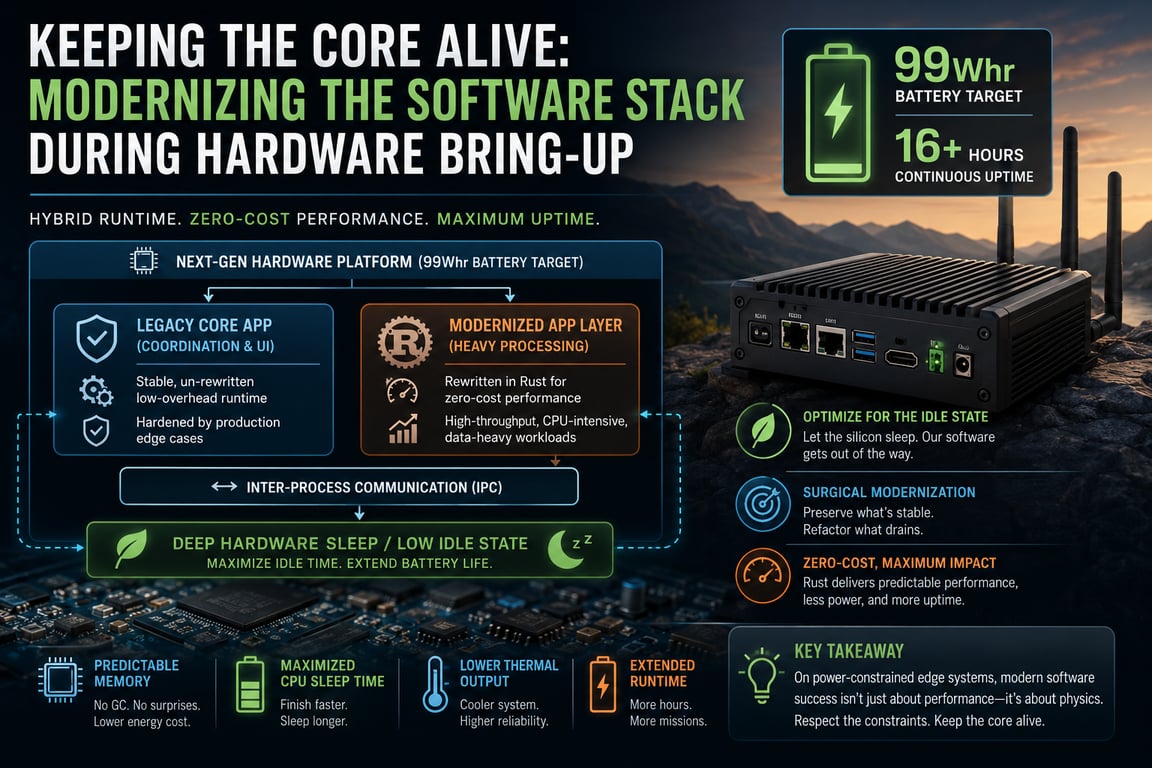
Rather than pursuing a complete rewrite, we adopted a hybrid architecture that combined proven legacy components with modern systems programming techniques. The result was a platform that delivered improved performance and efficiency without sacrificing operational stability.
The Reality of Resource-Constrained Systems
Cloud systems can often compensate for inefficient software by allocating additional compute resources.
Edge systems don't have that luxury.
Every CPU cycle consumes energy. Every unnecessary memory allocation impacts performance. Every background process can prevent the processor from entering low-power states.
Many legacy applications were designed when hardware constraints were different. While these systems may be operationally stable, they often rely on runtimes and execution models that were not optimized for modern power-efficiency requirements.
This creates a difficult challenge: how do you modernize a mature platform without introducing the risks associated with a complete rewrite?
The Hybrid Modernization Strategy
Instead of replacing everything at once, we treated modernization as a targeted optimization problem.
The existing application continued serving as the orchestration and coordination layer, while computationally intensive workloads were migrated to more efficient components built using systems-level technologies.
┌──────────────────────────────────────────────┐
│            Modernized Platform               │
└───────────────────┬──────────────────────────┘
                    │
        ┌───────────┴───────────┐
        ▼                       ▼
┌─────────────────┐   ┌─────────────────────┐
│ Existing Core   │   │ Processing Services │
│ Coordination    │   │ Performance-Critical│
│ Configuration   │   │ Components          │
└────────┬────────┘   └──────────┬──────────┘
         │                       │
         └───────────┬───────────┘
                     │
                     ▼
        ┌───────────────────────────┐
        │ Efficient Resource Usage  │
        │ Reduced CPU Wakeups       │
        │ Lower Memory Overhead     │
        └───────────────────────────┘
Preserve What Already Works
Mature software often contains years of accumulated operational knowledge.
Configuration systems, orchestration logic, workflows, and domain-specific behaviors may have evolved through countless production scenarios.
Replacing these components simply because newer technologies exist rarely provides sufficient return on investment.
By preserving proven orchestration layers, teams can avoid introducing unnecessary regressions while continuing to benefit from years of operational hardening.
Modernize High-Impact Components
Not every component contributes equally to resource consumption.
Some services spend most of their time waiting for events and require minimal CPU usage. Others continuously process data, perform transformations, or execute compute-intensive workloads.
These performance-critical components are often ideal candidates for modernization.
By moving computationally expensive workloads into highly efficient native binaries, teams can reduce runtime overhead, improve execution speed, and minimize resource consumption.
The goal isn't necessarily faster peak performance.
The goal is completing work quickly enough that the system can return to an idle state sooner.
Why Efficient Execution Matters
One of the most overlooked aspects of performance engineering is idle time.
Many teams focus exclusively on benchmark numbers, throughput, or latency.
In resource-constrained environments, efficiency is often more important than raw speed.
A workload that completes quickly and allows the processor to return to a low-power state may consume significantly less energy than a slower implementation that keeps hardware active for longer periods.
This principle influences several architectural decisions:
Reduce unnecessary background processing.
Eliminate excessive polling.
Minimize memory allocation churn.
Complete workloads as efficiently as possible.
Allow the underlying hardware to remain idle whenever possible.
The most efficient software is often software that spends the least amount of time running.
A Framework for Deciding What to Rewrite
Modernization decisions should be driven by measurable impact rather than technology trends.
When evaluating a component, consider the following criteria:
Evaluation Area | Preserve Existing Component | Modernize or Rewrite |
|---|---|---|
Domain Complexity | Contains years of operational knowledge and edge-case handling | Primarily performs isolated processing tasks |
Resource Consumption | Minimal CPU and memory usage | Significant CPU, memory, or I/O overhead |
Hardware Interaction | Generic platform services | Performance-sensitive or hardware-aware workloads |
Verification Effort | Difficult and expensive to validate | Easy to benchmark and test independently |
Business Risk | Core operational workflows | Self-contained components with limited blast radius |
This framework helps teams focus modernization efforts where they deliver the greatest value while minimizing unnecessary risk.
Lessons for Engineering Leaders
Software Is Part of the Hardware Budget
In constrained environments, software architecture directly influences power consumption, thermal behavior, and system longevity.
Treat software efficiency as a first-class engineering requirement rather than a post-launch optimization.
Incremental Modernization Beats Large Rewrites
Complete rewrites often underestimate the complexity hidden inside mature systems.
Targeted modernization allows teams to improve critical areas while preserving proven operational behavior.
Optimize for Idle Time
Peak performance metrics only tell part of the story.
In many systems, the real goal is reducing the amount of time hardware must remain active.
The faster a workload completes, the sooner the system can return to doing nothing-and doing nothing is often the most efficient state of all.
Final Thoughts
Modernization does not have to mean replacing everything.
By preserving stable components, selectively modernizing resource-intensive workloads, and focusing on measurable operational outcomes, engineering teams can significantly improve efficiency without sacrificing reliability.
The most successful modernization efforts are rarely the most ambitious. They are the ones that respect existing systems, understand real-world constraints, and apply change only where it delivers meaningful value.