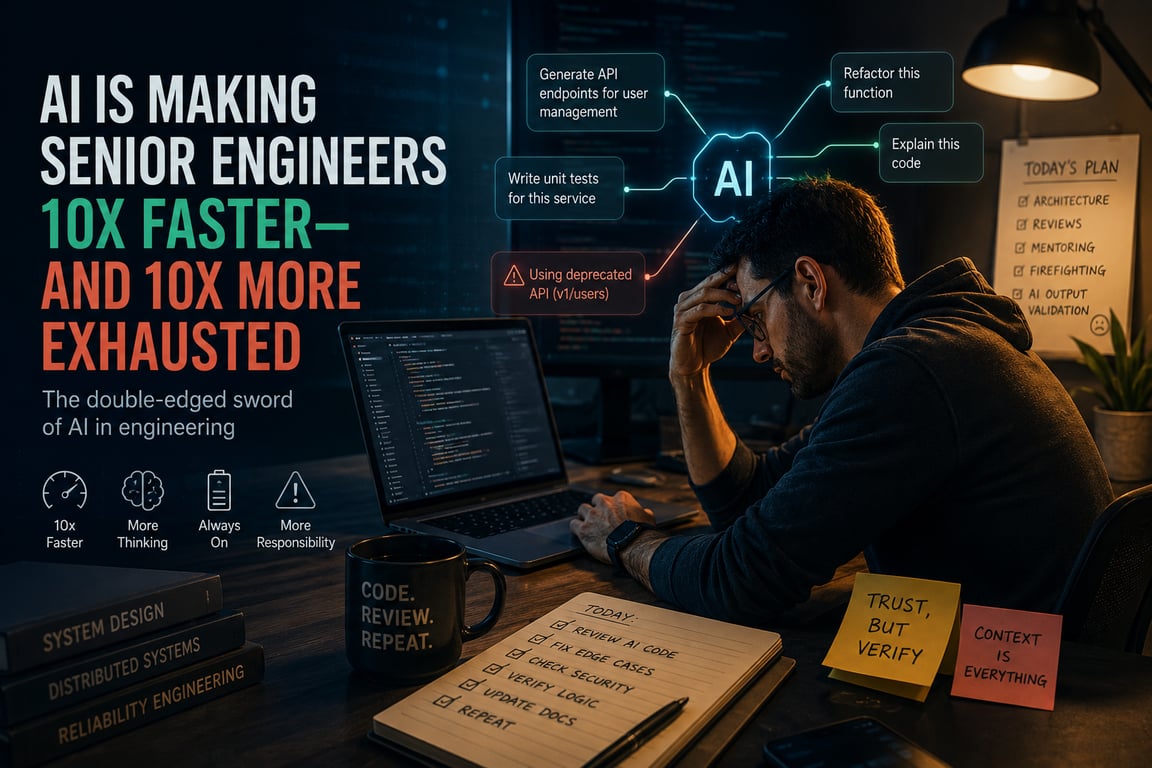
AI Is Making Senior Engineers 10x Faster - And 10x More Exhausted
When AI coding tools first appeared, I thought:
“Nice. Less boilerplate.”
Now it sometimes feels like I’m managing a team of infinitely fast junior engineers that never sleep, occasionally hallucinate, and submit pull requests every 30 seconds.
As a senior engineer, AI has made parts of my work much faster. It has also increased the amount of attention I have to spend deciding what is safe, useful, and worth keeping.
Both things can be true at the same time.
The “10x” in the title is rhetorical, not a measured productivity claim. Some tasks genuinely shrink from hours to minutes. Others simply move the effort: from typing code to framing the problem, checking assumptions, reviewing output, testing behavior, and owning the consequences after release.
That distinction matters. Faster code generation is valuable. It is not the same thing as faster engineering.
The Good Part: AI Removes a Lot of Friction
There is plenty to like. Used well, LLMs are helpful for repetitive and bounded work:
scaffolding a familiar endpoint or component
writing a first pass at tests and fixtures
summarising an unfamiliar module before reading it closely
suggesting a refactor after the desired design is clear
drafting SQL, migrations, documentation, or scripts
turning notes into a checklist, rollout plan, or incident update
For those jobs, AI can reduce blank-page time and context switching. It can make a prototype cheap enough to test. It can also give experienced engineers more room to focus on the parts that need judgment: product trade-offs, system boundaries, failure modes, and maintainability.
That is real leverage. But leverage only helps when it is pointed in the right direction.
The Trade-Off: More Output Creates More to Validate
The uncomfortable part is that AI changes the shape of senior work. It makes it easy to produce plausible code quickly, including code that is subtly wrong for a particular system.
An assistant does not know the full history behind a strange-looking guard clause, the operational constraint hidden in an old incident report, or the business rule that lives outside the repository. It may infer those things correctly. It may also confidently invent an API, miss an authorization boundary, choose an unsafe default, or optimise the visible path while breaking an important edge case.
That means the senior engineer is not just authoring less. They are acting as editor, reviewer, systems thinker, and accountable owner for a larger stream of generated output.
The risk is not that every AI suggestion is bad. Many are perfectly serviceable. The risk is that clean, fluent code can create an illusion of understanding. Code that looks conventional is easier to accept before anyone has verified that it fits the domain.
So the bottleneck often moves from production to validation:
Does this satisfy the actual requirement, not just the prompt?
What assumptions did it make about data, permissions, latency, or failure?
Does it fit existing conventions and architectural boundaries?
Can the team explain, test, operate, and change it later?
Those are engineering questions. AI can assist with them, but it cannot take ownership of the answer.
Use AI Inside a Deliberate Review Workflow
My most useful rule is simple: generated code should enter the same engineering workflow as any other change. “The model wrote it” is not a reason to lower the bar; if anything, it is a reason to make the path to production more explicit.
A practical workflow looks like this:
Start with the outcome and constraints. Write down the user-facing behavior, non-goals, invariants, affected systems, and rollback plan before asking for an implementation.
Ask for a small change. Prefer one function, one module, or one narrow slice over a large, multi-file rewrite. Smaller diffs are easier to understand and review.
Read the diff as the owner. Do not review it like a copy editor. Trace important inputs and outputs, error paths, state changes, and permission checks.
Run the evidence. Build, lint, type-check, test, and exercise the relevant behavior locally or in a safe environment. Add the tests that would have caught the failure you are worried about.
Use human review for the meaningful change. A second engineer is especially useful when the work crosses service boundaries, changes data, affects security, or introduces a new abstraction.
Release with observability and a way back. Feature flags, metrics, logs, alerts, and a rollback path turn uncertainty into something manageable.
This is not bureaucracy for its own sake. It is how a team prevents speed at the keyboard from becoming risk in production.
Context and Design Still Come First
Good prompts help, but “context engineering” is more than writing a clever instruction. It is the work of making the problem legible: what the system does, where the boundaries are, what must not change, and how success will be observed.
Before generating implementation code, I try to provide or decide:
the desired behavior and examples of valid and invalid cases
the relevant interfaces, schemas, and repository conventions
performance, privacy, security, and compatibility constraints
which dependencies are allowed and which patterns are off limits
the tests, metrics, or acceptance criteria that define “done”
For complex work, it is often better to ask AI for options than for a finished patch. Ask it to identify trade-offs, list likely failure modes, or compare approaches against stated constraints. Then make the design decision deliberately. Once the design is clear, generation becomes much safer and faster.
The senior skill is not producing the largest prompt or accepting the most output. It is reducing ambiguity before output exists.
Quality Guardrails Make Speed Safer
Guardrails are not a substitute for judgment, but they reduce the chance that a rushed change becomes a costly surprise.
At a minimum, teams should keep the ordinary safeguards healthy: formatting, linting, type checks, automated tests, dependency and secret scanning, code review, and CI that blocks obvious regressions. The exact stack will vary, but the principle is stable: make the safe path the easy path.
AI-assisted work deserves a few additional habits:
Keep pull requests reviewable. Split mechanical changes from behavioral changes. Avoid combining a broad refactor with a feature unless there is a compelling reason.
Require ownership of every line. The author should be able to explain why the code exists, what it assumes, and how it fails.
Treat generated dependencies and snippets with caution. Verify package names, licenses, versions, APIs, and security implications rather than trusting a suggestion.
Test boundaries, not only happy paths. Focus on authorization, concurrency, retries, partial failure, malformed input, migration safety, and backward compatibility where relevant.
Protect sensitive context. Follow company policy for source code, credentials, customer data, and internal documents. A convenient prompt should not become a data-handling mistake.
These practices help regardless of who wrote the first draft. AI just makes their absence easier to notice because it can create so much change so quickly.
AI Changes Team and Process, Not Just Individual Productivity
The biggest effects are often social. If one person can generate a large patch in an afternoon, review queues can fill faster than reviewers can reason about them. If every task is treated as instant because a tool exists, planning becomes disconnected from integration, verification, and operational work.
Teams should therefore measure more than throughput. Deployment confidence, escaped defects, incident load, lead time through review, on-call pain, maintainability, and the ability of more than one person to work on a system all matter. A higher count of merged lines or tickets is not automatically progress.
There is also a learning concern. Junior engineers still need feedback loops that teach them to reason about systems, debug failures, and make trade-offs. Giving them generated solutions without discussion may accelerate a task while weakening the path to independent judgment. Pairing, design reviews, and asking people to explain a proposed change are more valuable, not less, when code is cheap to produce.
For senior engineers, the role increasingly includes setting norms: when AI is appropriate, what must be disclosed in a pull request, which checks are mandatory, and when a design conversation should happen before generation. Clear expectations reduce both risk and resentment.
Sustainable AI Use Means Protecting Attention
The exhaustion is not caused only by more work. It comes from rapid switching: prompt, inspect, correct, test, prompt again, answer review comments, and repeat. Constantly evaluating plausible output can be mentally expensive, especially when the code touches unfamiliar parts of a system.
To make AI useful without letting it consume the day, I try to use it intentionally:
Batch exploratory prompting instead of interrupting every few minutes.
Reserve uninterrupted time for design, deep reading, and difficult debugging.
Stop generating when I cannot clearly articulate what I am asking for.
Prefer a small, understood solution over a large “complete” patch.
Use checklists for repeatable review work so attention is saved for the novel risks.
Leave a decision record when the reasoning will matter to the next person.
Sometimes the fastest move is to write the small piece of code yourself. Sometimes it is to ask AI for a test matrix or a second opinion. Sustainable use is not maximising prompts. It is choosing the tool mode that preserves clarity and energy for the work only humans on the team can do.
The Real Leverage Is Judgment
AI is making some parts of senior engineering faster, sometimes dramatically. It is also making judgment, review, context, and operational responsibility more visible.
That does not make the tools a mistake. It makes the surrounding discipline more important. Use AI to remove friction, accelerate exploration, and handle bounded work. Keep humans responsible for design, validation, trade-offs, and the health of the system over time.
The goal is not to generate code as fast as possible. The goal is to ship changes the team understands, can support, and can improve without burning out the people accountable for them.