The Golden Rule of Payout Systems: Why "Pending" is Never a Failure
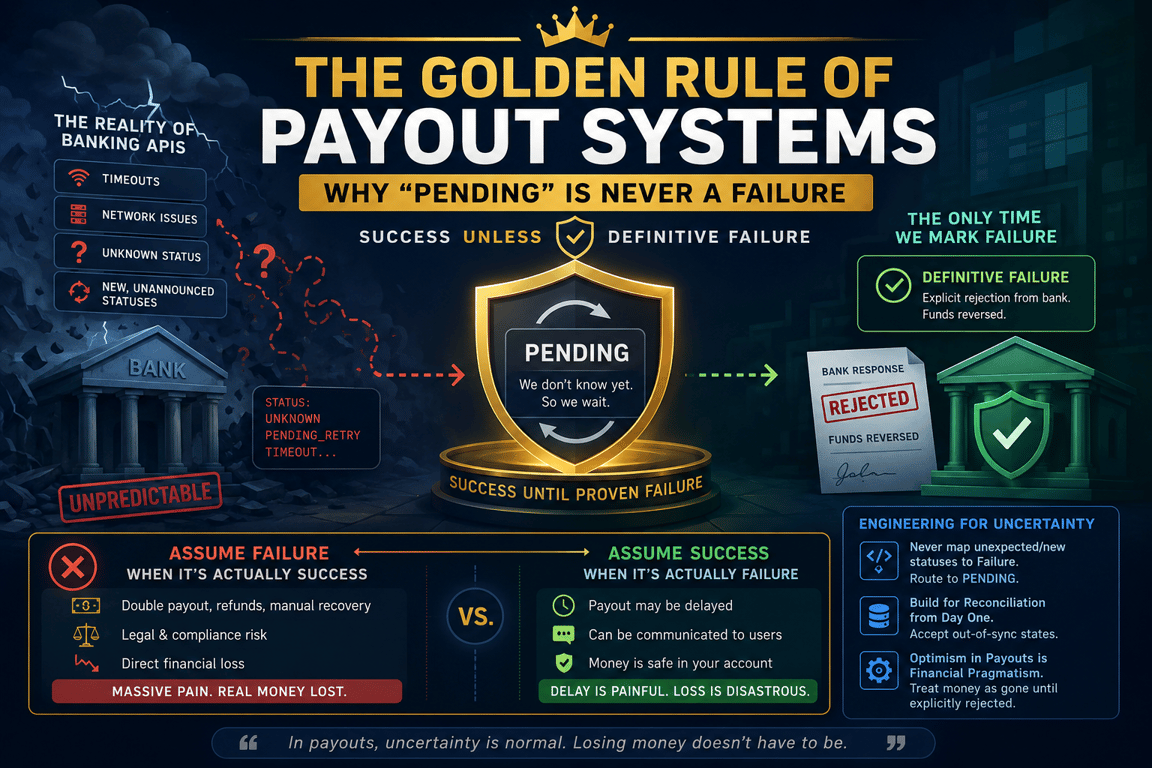
A timeout means your application did not receive a final answer. It does not prove that a bank, payment gateway, or payment partner did not receive or process the payout request.
That distinction is the foundation of safe payout design. When a payout outcome is uncertain, the system should preserve it as pending until it receives reliable evidence that the payout completed or failed. Treating uncertainty as failure can make funds available for a second transfer while the first transfer is still moving through the payment rail.
The result is one of the most expensive errors in payments: a duplicate payout.
A payout is not a synchronous request
A simple architecture diagram suggests a clean sequence:
A user requests a payout.
Your application calls a payment API.
The partner returns success or failure.
Your database records the result.
That model is useful for a happy-path demo. It is incomplete for production money movement.
A payout can cross several systems before the recipient receives funds:
User
  |
  v
Your application
  |
  v
Payment partner
  |
  v
Banking or payment rail
  |
  v
Recipient bank
  |
  v
Recipient account
Each boundary introduces failure modes that your application cannot observe directly. A network connection may close after the payment partner has accepted the request. A gateway may return an error while its internal worker continues processing. A payment rail may accept an instruction but delay its final result.
From your application’s perspective, several different events can look exactly the same:
Request sent
  |
  +--> Partner never received it
  |
  +--> Partner received it but did not process it
  |
  +--> Partner accepted it and is still processing it
  |
  +--> Payout completed, but the response never reached you
A timeout tells you only one thing: the caller has no final response. It says nothing conclusive about whether money movement started.
That is why a payment API response is not always the final source of truth. The payment flow may continue after the HTTP request has ended.
The state that systems often miss
Many applications model a transaction with two terminal states:
success
failure
Payout systems need a third state:
unknownIn implementation, that state is often named pending, processing, submitted, or status_unknown. The label is less important than its behavior.
An uncertain payout must not behave like a failed payout.
It should not:
Restore funds for a new payout automatically.
Trigger a new payout attempt with a new external reference.
Be removed from operational records.
Be treated as resolved because an API call failed locally.
It should remain visible and traceable until the system can establish an outcome.
Consider a timeout after a payout submission:
Payout initiated
  |
  v
Request sent to partner
  |
  v
Network timeout
  |
  v
Outcome unknown
An unsafe implementation turns that timeout into a failure:
Timeout
  |
  v
Mark payout failed
  |
  v
Restore user balance
  |
  v
Allow a new payout
If the first request was accepted before the timeout, the user can now create a second payout using money that is already committed to the first one.
The application has created a duplicate-payment risk because it replaced uncertainty with an unsupported conclusion.
Why a false failure costs more than a delay
Every payout platform balances two risks.
The first risk is a delayed payout. The user sees a pending state for longer than expected. Support may need to answer questions. The payout may require reconciliation before it reaches a terminal state.
The second risk is a false failure. The original payout succeeds, but the platform decides it failed and makes the funds available again.
These risks are not equivalent.
Delayed resolution
When a payout remains pending:
The user may have to wait.
The funds may remain unavailable temporarily.
Support volume may increase.
Operations may need to review exceptions.
Those costs matter. They are usually contained and reversible.
False failure
When a completed payout is marked failed:
The recipient may receive money twice.
The ledger can show an incorrect available balance.
A refund or retry may create another transfer.
Finance teams may need manual investigation.
Recovering funds may depend on recipient cooperation.
Audit and reporting records become harder to explain.
A pending payout creates an operational problem. A false failure can create a financial loss.
This is why payout systems should prefer delayed certainty over an incorrect terminal state. The default should be conservative:
A payout is not failed until an authoritative source confirms final failure.
Build a state machine that preserves uncertainty
The rule must exist in code, not only in documentation. A clear state machine prevents workers, webhooks, API handlers, and support tools from applying conflicting decisions.
A basic model can look like this:
created
  |
  v
submitting
  |
  +--> pending
  |      |
  |      +--> completed
  |      |
  |      +--> failed
  |
  +--> failed
The important rule is that failed requires evidence.
created
  -> submitting
  -> pending
  -> completed

submitting + documented final rejection
  -> failed

submitting + timeout or connection reset
  -> pending

pending + confirmed completion
  -> completed

pending + confirmed final rejection
  -> failed
A timeout is not a final rejection. A connection reset is not a final rejection. An unrecognized response is not a final rejection.
Even an HTTP 5xx response should not automatically mean the payout failed unless the payment partner explicitly documents that response as proof the request was not accepted or processed.
Separate transport status from payout status
Transport signals describe communication between systems. Payment states describe the outcome of money movement. They should not be treated as the same thing.
Signal | What it proves | Safe payout state |
|---|---|---|
Request accepted by partner | The partner accepted the submission |
|
Documented terminal success | The partner reports a completed outcome |
|
Documented terminal rejection | The partner reports the payout cannot proceed |
|
Timeout or connection reset | Your application lacks a response |
|
Invalid or incomplete response | The response cannot establish outcome |
|
Persist the original payout intent before sending the external request. Keep the fields needed to resolve it later:
Internal payout ID
Idempotency key
Attempt ID
External reference, when available
Amount and currency
Recipient identifier or beneficiary reference
Submission time
Latest known external status
Raw partner response or error details, where appropriate
Do not overwrite earlier evidence when a later status check changes the payout state. An audit trail is essential when support or finance teams need to reconstruct what happened.
Retries need idempotency
Retries are necessary in distributed systems. They are also one of the main ways duplicate payouts occur.
The core rule is simple:
Retry an uncertain submission only when the receiving system can identify it as the same payout attempt.
That usually means sending a stable idempotency key.
Payout intent: payout_123
Attempt: attempt_001
Idempotency key: idem_abc
If the request times out, a transport retry should use the same idempotency key:
Retry submission
  |
  v
Idempotency key: idem_abc
The receiving system can then return the existing result or continue the original request instead of creating a second payout.
A new idempotency key changes the meaning of the request:
Retry submission
  |
  v
Idempotency key: idem_xyz
Depending on the partner’s behavior, that may be interpreted as a brand-new payout.
Transport retries and business retries are different
A transport retry attempts to deliver the same request again. It uses the same idempotency key and should refer to the same payout attempt.
A business retry happens after a confirmed terminal failure. It creates a new payout attempt because the old one is known not to have completed.
Payout intent: payout_123

Attempt 1
  idempotency key: idem_abc
  final status: failed

Attempt 2
  idempotency key: idem_def
  final status: pending
The payout intent connects both attempts. The attempt IDs and idempotency keys keep their external submissions distinct.
Before creating a new business retry, check whether the earlier attempt has a confirmed terminal status. If the old attempt is still unknown, resolve it through a status query or reconciliation process first.
if finalFailureConfirmed(attempt):
  createNewAttempt(payoutIntent)
else if outcomeUnknown(attempt):
  queryPartnerStatus(attempt)
  scheduleReconciliation(attempt)
else:
  continueNormalProcessing(attempt)
If a provider does not support idempotency, automatic retries after an unknown outcome are unsafe. Queue the payout for review or status resolution instead.
Reconciliation resolves what APIs cannot
A synchronous API response captures one point in time. Reconciliation compares your internal records with external payment records after the fact.
It closes the gap between:
What your application thinks happened.
What the payment partner reports.
What the banking or payment rail processed.
For payouts that remain pending, reconciliation should compare the details that identify a transaction:
Internal and external references
Amount and currency
Beneficiary details or recipient reference
Submission date and time
Latest known partner status
Settlement or completion records, where the rail provides them
The cadence should match the reporting and settlement behavior of the rail you operate. Some partners provide near-real-time status APIs. Others provide files or reports later. Your system should account for that delay rather than treating it as a failure.
Reconciliation is also an incident control
Reconciliation can reveal problems that request-response processing cannot:
A payout completed after a client timeout.
A payout marked completed without a matching external record.
Multiple external submissions for the same payout intent.
A pending payout that has exceeded its expected resolution time.
A mismatch between ledger entries and payment records.
Every mismatch should enter an exception queue with an owner, an audit note, and a next action. A queue without ownership is only a list of unresolved risk.
Operational rules and common mistakes
Rules that keep uncertainty safe
Keep funds unavailable for a second payout while the first outcome is unknown. The exact accounting treatment depends on the product, but the same balance must not support two active payout attempts.
Make state transitions idempotent. A repeated webhook, reconciliation record, or worker retry must not apply ledger changes twice.
Use webhooks as signals, not the only record. Webhooks can arrive late, repeat, or fail to arrive. Combine them with status queries and reconciliation.
Record every payout attempt. Do not delete ambiguous records. They hold the identifiers required to determine the outcome.
Alert on stale pending payouts. Define expected resolution windows by rail and route overdue cases to operations.
Give support useful context. Show the payout reference, current state, latest update, last status check, and planned next step.
Common mistakes
Refunding immediately after a timeout
A timeout can occur after the payment partner accepted the request. Restoring the balance immediately can make the funds available for another payout.
Use pending until a final result is confirmed.
Retrying with a new idempotency key
A new key may tell the partner to create another payout rather than resume or return the existing one.
Reuse the original key for a transport retry. Create a new key only for a confirmed new attempt.
Treating HTTP success as settlement
An accepted request is not always a completed payout. It may still be queued, screened, rejected later, or waiting on another system.
Model acceptance and completion as separate states when the payment rail requires it.
Treating a webhook as final proof without validation
A webhook should be authenticated, deduplicated, and checked against the payment partner’s documented status model. It may be delayed or repeated.
Removing ambiguous records to keep dashboards clean
An unresolved payout is not noise. It is a financial record that requires a final outcome. Keep it visible until reconciliation resolves it.
Key takeaways
A timeout means the caller lacks an answer. It does not prove a payout failed.
Model uncertainty as a durable
pending,processing, orstatus_unknownstate.Move a payout to
failedonly with reliable evidence of a terminal rejection.Use stable idempotency keys for transport retries.
Treat confirmed failures as new business attempts, with new attempt records.
Reconcile non-final payouts against the authoritative records available for the payment rail.
Prefer a temporary pending state over a duplicate transfer.
Conclusion
Payout systems must be designed for incomplete information. Networks fail, responses disappear, and external systems may continue processing after your request has timed out.
The safe response is not to guess.
When the payout outcome cannot be proven, preserve the state as pending, retain the identifiers needed to investigate it, and reconcile it until a final result is available. That choice may delay resolution, but it prevents the system from turning uncertainty into a duplicate payment.
Coming Next Week
Next week, I’ll share four AI agent skills I use to make my coding workflow faster, clearer, and easier to manage.
A practical look at the small systems behind better AI-assisted engineering.